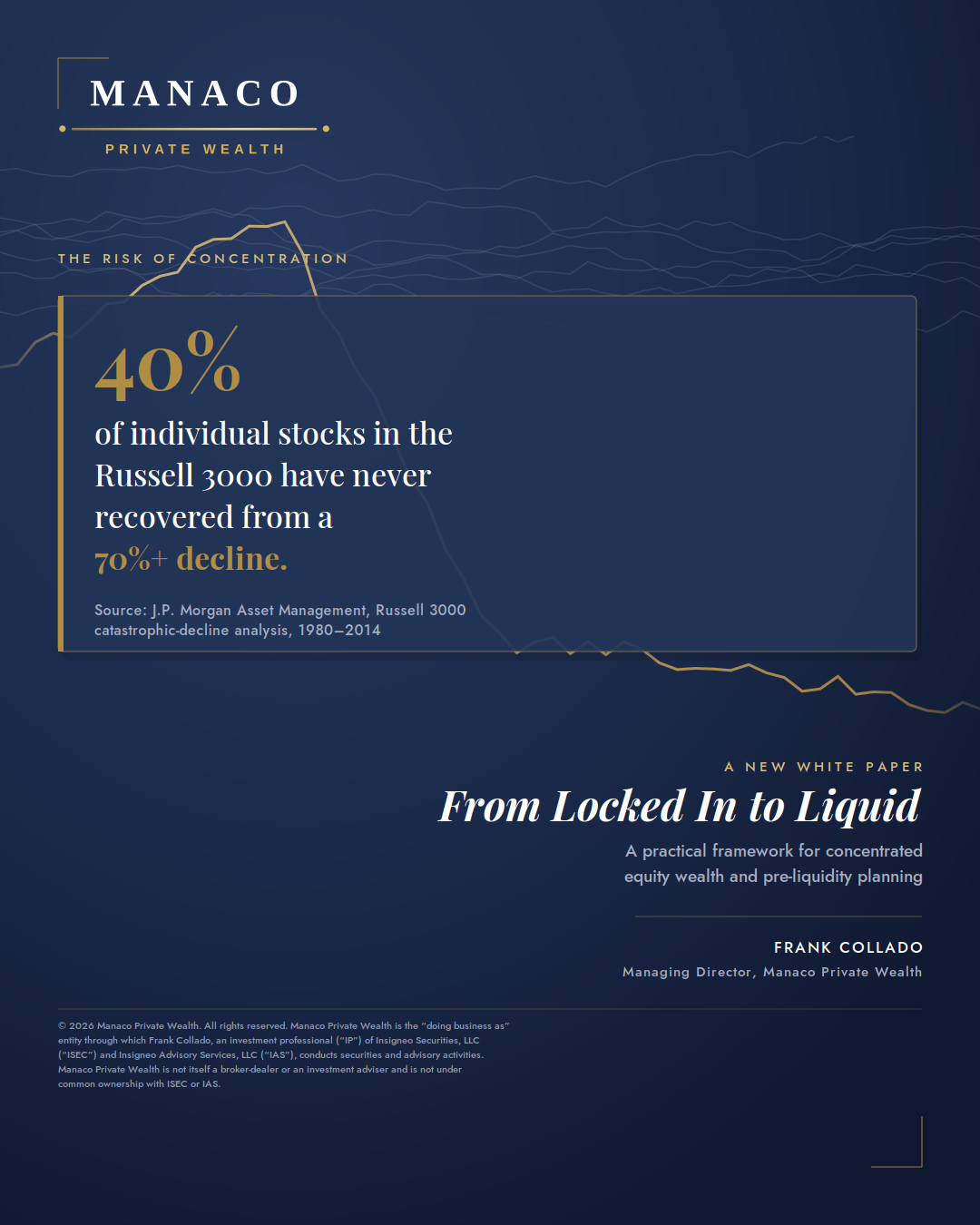
A New White Paper
From Locked In
to Liquid
A practical framework for concentrated equity wealth and pre-liquidity planning.
A practical framework for concentrated equity wealth and pre-liquidity planning.
of individual stocks in the Russell 3000 have never recovered from a 70%+ decline.
Source: J.P. Morgan Asset Management, Russell 3000 catastrophic-decline analysis, 1980–2014.
A founder's equity, a long-tenured executive's vested stock, or a family's inherited block of shares can represent decades of value creation. But it also means a single company's fortunes, not a diversified market, determine a client's financial future. Historical data on the Russell 3000 going back to 1980–2014 shows that roughly 40% of individual stocks experienced a catastrophic decline, defined as a 70% drop from peak that was never recovered. Even in strong market years, individual stocks behave nothing like the index that contains them: in 2023 and 2024, when the S&P 500 rose roughly 26% and 25% respectively, 72% and 68% of the stocks in that index still experienced a maximum drawdown of at least 15% at some point during the year.
For clients holding a concentrated position - whether from an IPO, a founder's stake, restricted stock, or an inheritance - the central challenge is rarely whether to diversify. It is how to do so without an unnecessary tax cost, without violating trading restrictions, and without giving up more upside than the risk reduction is worth. This paper surveys the main pre-liquidity planning tools available today, from systematic sale programs and exchange funds to QSBS planning and the fast-growing pre-IPO secondary market, and offers a framework for matching the right tool to a client's specific situation.
This paper addresses concentrated equity positions - founder, executive, and inherited stock, including pre-IPO and QSBS holdings. Concentrated fixed income, real estate, and sale proceeds held in escrow or earnout are related but distinct situations outside its scope.
"Roughly 40% of individual stocks in the Russell 3000 have experienced a decline of 70% or more from their peak that was never recovered." Source: J.P. Morgan, "The Agony & The Ecstasy: The Risks and Rewards of a Concentrated Stock Position," Russell 3000 catastrophic-decline analysis, 1980–2014.
A concentrated position is generally defined as a single holding that represents more than 10% to 20% of an investor's portfolio or net worth, though many advisors apply a lower threshold, around 5%, when the position is illiquid or restricted. The risk is not merely theoretical: a Parametric Portfolio Associates analysis found that in 2022, when the S&P 500 fell 18.1%, 96% of the stocks in the index experienced a maximum drawdown of at least 15%, and 32% experienced a drawdown of at least 40%.
What makes concentrated positions especially difficult to manage is that the risk is often compounded by circumstance. Executives and founders frequently face insider trading restrictions, blackout windows, and vesting schedules that limit when they can sell. Many also carry an emotional attachment to the stock that built their wealth, along with a deeply embedded low-cost basis that makes a straightforward sale expensive from a tax standpoint. The result is that most investors delay diversifying - not because it is unwise, but because the mechanics of doing so are genuinely complicated.
Selling a concentrated position outright is the simplest way to reduce risk, but it is rarely free. Under current federal law, long-term capital gains are taxed at 0%, 15%, 18.8% (the 15% bracket plus the 3.8% Net Investment Income Tax), or 23.8% (the top 20% bracket plus NIIT), depending on the taxpayer's income - with the 20% bracket applying to taxable income above $545,500 (single) or $613,700 (joint) in 2026. State and local taxes can add materially more on top of the federal rate.
For a holder with a very low-cost basis, an outright sale can mean losing 25% to 30% or more of the position's value to taxes in a single transaction - which is precisely why so much of pre-liquidity planning is really tax planning in disguise.
No single tool fits every concentrated holder. Here's a summary of the seven strategies covered in depth in the full paper.
A multi-year, incremental sale program that spreads capital gains recognition across several tax years. For insiders, typically implemented via a pre-arranged Rule 10b5-1 trading plan.
Contribute a concentrated position to a pooled partnership for a diversified basket, without triggering a taxable sale under IRC Section 721. Typically a seven-year lock-up.
Protective collars and covered calls manage downside risk without an immediate sale - useful when trading restrictions or personal conviction favor continuing to hold.
Donating appreciated stock directly - via a donor-advised fund or charitable remainder trust - avoids capital gains tax on the appreciation entirely.
Gifting shares outright or into an irrevocable trust reduces concentration while moving future appreciation out of the donor's taxable estate.
For Qualified Small Business Stock under IRC Section 1202, a tiered exclusion can shelter up to the greater of $15 million or 10x basis in gain - the one tool that eliminates, rather than defers, tax.
A fast-growing secondary market - Nasdaq Private Market, Forge, EquityZen, and others - lets employees and early investors access liquidity before a company goes public.
The right combination depends on the size of the embedded gain, the client's liquidity timeline, whether the stock is publicly traded or still private, and whether trading restrictions apply.
| Strategy | Best Suited For | Key Trade-Off |
|---|---|---|
| Systematic sale / 10b5-1 | Public company insiders who can tolerate a multi-year timeline | Position stays concentrated, and risky, throughout the sale period |
| Exchange fund | Very low-basis holders with high current tax rates, no near-term liquidity need | Seven-year lock-up; high minimums; tax deferred, not eliminated |
| Options collar / calls | Holders who must or want to keep the stock | Caps upside; ongoing cost and complexity |
| Charitable remainder trust / DAF | Philanthropically inclined clients with appreciated stock | Assets irrevocably committed to charitable purposes |
| Gifting to family or trusts | Clients focused on intergenerational transfer | Uses lifetime gift exemption above the annual exclusion |
| QSBS planning | Founders and early employees in qualifying C-corps | Highly technical eligibility rules |
| Pre-IPO secondary sale | Employees and early investors in still-private, late-stage companies | Requires company approval; pricing less transparent |
A sequence of questions a client can actually answer. It is not a replacement for advice, but it helps locate the right starting point quickly.
Note: most real plans blend several tools rather than choosing just one.
Two illustrative cases show how these tools combine in practice. Names and figures are illustrative.
Maria, 45, is a co-founder and director of a software company that IPO'd 18 months ago. Her post-lockup position totals $20 million against a $500,000 cost basis - nearly all long-term gain. An outright sale would trigger roughly $4.64 million in federal tax, leaving about $15.36 million after tax.
A layered plan fits her facts better than any single tool:
David, 52, founded a C-corporation manufacturing company and acquired founder shares at original issue in August 2025. He holds for five-plus years and sells in 2031 for a $15 million gain.
Because his stock qualifies as QSBS acquired after July 4, 2025, the OBBBA's tiered exclusion applies: 100% of the gain is federally excluded at the $15 million cap. David owes $0 in federal tax - versus roughly $3.57 million had the same gain been ordinary diversified stock.
A concentrated position is often the clearest evidence of a client's success, and also one of the more urgent risks in their financial life. The toolkit available to address it has never been more developed - systematic sale programs, exchange funds, options overlays, charitable structures, QSBS planning, and a rapidly maturing pre-IPO secondary market all offer different paths to the same basic goal: converting concentrated, illiquid, or restricted wealth into a diversified position without giving away more value than necessary along the way.
It is an honest inventory of the position's basis, restrictions, and the client's true liquidity timeline, followed by a coordinated plan that draws on more than one of these tools where appropriate. Clients who begin that conversation early - well before a sale is imminent or a company files for its IPO - generally have the most options and the best outcomes.
One of the greatest challenges successful individuals and families face is not creating wealth - it is preserving it, managing it thoughtfully, and transitioning it efficiently. - Frank Collado, Managing Director, Manaco Private Wealth

Frank Collado is Managing Director of Manaco Private Wealth, the "doing business as" entity through which he, an investment professional of Insigneo Securities, LLC and Insigneo Advisory Services, LLC, conducts securities and advisory activities, advising high-net-worth individuals, families, business owners, executives, and cross-border clients on investment management and comprehensive wealth planning strategies.
Frank's approach reflects a multi-generational mindset - coordinating tax planning, estate strategy, liquidity planning, banking relationships, philanthropic planning, and trusted legal and tax professionals around each client's full picture, rather than focusing solely on investment portfolios.
J.P. Morgan Asset Management (Michael Cembalest), "The Agony & The Ecstasy: The Risks and Rewards of a Concentrated Stock Position," September 2014.
Parametric Portfolio Associates, "Four Potential Solutions to Concentrated Stock Positions," citing FactSet data, 2026.
Kitces.com, "When To Use Exchange Funds To Diversify Concentrated Stock Positions," April 2026.
Internal Revenue Code Section 1202, as amended by the One Big Beautiful Bill Act (Pub. L. 119-21), 2025.
Jefferies Global Secondary Market Review, February 2026, via Cerity Partners.
Nasdaq Private Market, company liquidity data, May 2026.
Intel Market Research, "Pre-IPO Private Share Trading Market Outlook 2026–2034," May 2026.
Full citations, figures, and client-scenario detail are available in the complete PDF.
Every client's circumstances are unique. If you'd like to discuss your own situation or explore the planning concepts in this paper, I welcome the opportunity to speak with you.
The views and opinions expressed in this paper are those of the author alone and do not necessarily reflect the views of Insigneo, its affiliates, or its officers. This document is an educational white paper and has been reviewed but not prepared or endorsed as an official publication of Insigneo.
This material is for informational and educational purposes only and should not be construed as investment, tax, legal, or accounting advice, or as an offer or solicitation to buy or sell any security or investment strategy. Strategies discussed - including concentrated stock planning, exchange funds, QSBS, charitable planning, estate planning techniques, options strategies, and pre-liquidity planning - may not be suitable for every investor. Tax laws are subject to change and vary by individual circumstance. Manaco Private Wealth, Insigneo Securities, LLC, and Insigneo Advisory Services, LLC do not provide legal or tax advice; consult your own qualified tax and legal professionals before implementing any strategy discussed here. Full disclosures are included in the downloadable PDF and in the site footer below.